

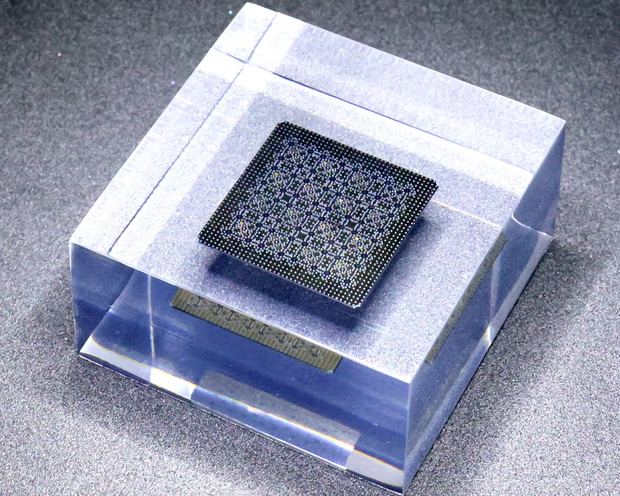
Google has claimed a breakthrough in quantum computing after developing an algorithm that performed a task beyond the capabilities of conventional computers.
The algorithm, a set of instructions guiding the operation of a quantum computer, was able to compute the structure of a molecule – which paves the way for major discoveries in areas such as medicine and materials science.
Google acknowledged, however, that real-world use of quantum computers remained years away.
“This is the first time in history that any quantum computer has successfully run a verifiable algorithm that surpasses the ability of supercomputers,” Google said in a blogpost. “This repeatable, beyond-classical computation is the basis for scalable verification, bringing quantum computers closer to becoming tools for practical applications.”
Michel Devoret, the chief scientist at Google’s quantum AI unit, who won the Nobel prize for physics this month, said the announcement was another milestone in his field. “This marks a new step towards full-scale quantum computation,” he said.
The algorithm breakthrough, enabling a quantum computer to operate 13,000 times faster than a classical computer, was detailed in a peer-reviewed paper published in Nature on Wednesday.
One expert cautioned that the Google achievement, while impressive, focused on a narrow scientific problem without significant real-world impact. The results for two molecules were cross-checked with nuclear magnetic resonance (NMR) – the same technology behind MRI scans – and revealed information not normally revealed by NMR.
Winfried Hensinger, a professor of quantum technologies at the University of Sussex, said Google had demonstrated “quantum advantage” – meaning its researchers had performed a task making use of a quantum computer that cannot be achieved using a classical computer.
But fully fault-tolerant quantum computers, capable of realising some of the tasks that most excite the scientific community, are still some way off as they would require machines capable of hosting hundreds of thousands of quantum bits – the term for a unit of information in a quantum computer.
Tags:
Subscribe To Get Update Latest Blog Post
No Credit Card Required
You May Also Like




Pakistan Rang is a leading Digital Media Publisher delivering cutting-edge content across news, entertainment, education, healthcare, lifestyle, Sports, and technology. Our platform engages millions with timely stories and insightful analysis. Committed to quality journalism and innovation, we connect audiences with the information they need and the stories that inspire and inform.


